

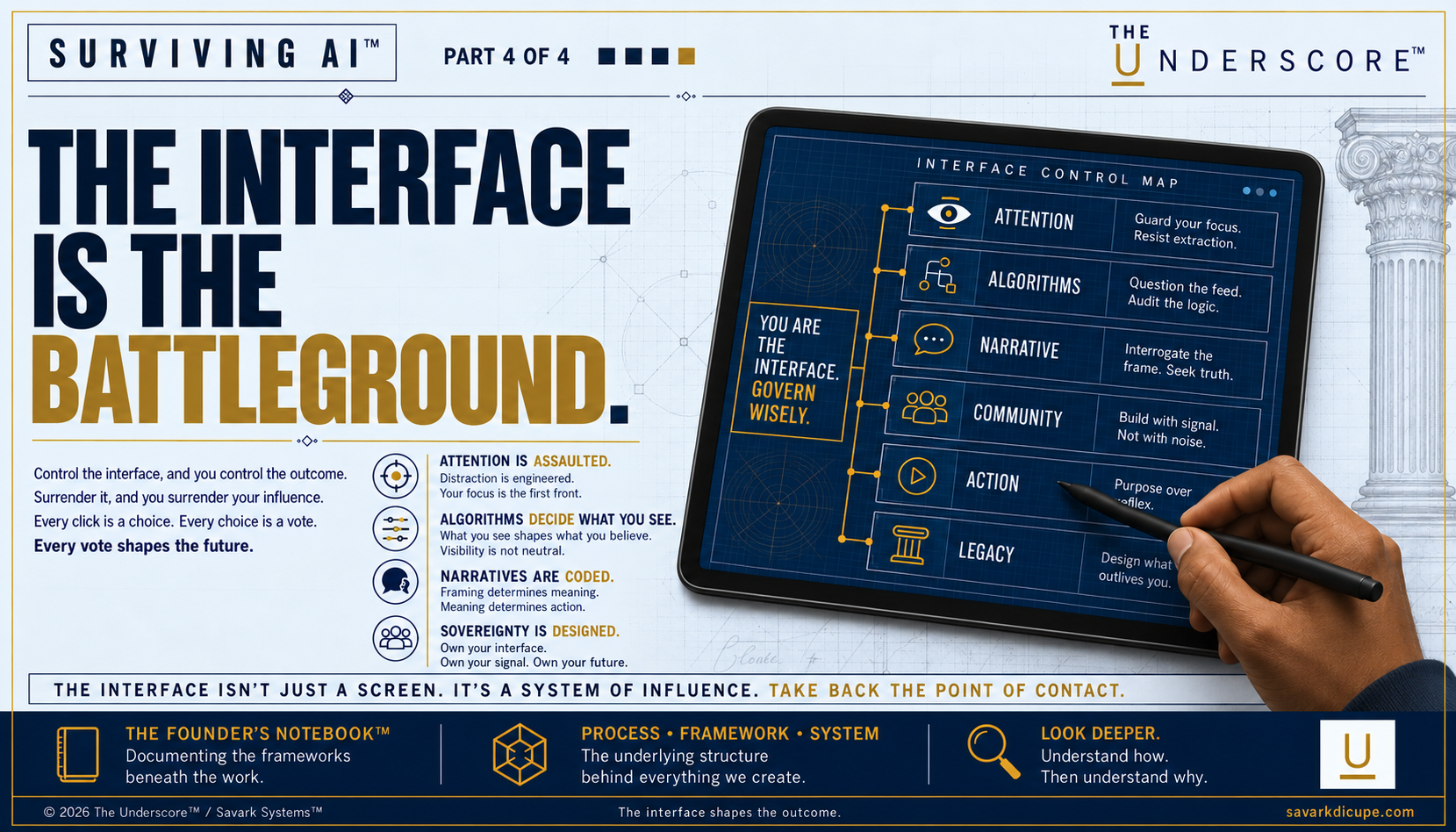
SURVIVING AI™ ― Part 4
Who am I?
My name is Savark Dicupé.
I am the Underlyter.
And that’s the wrong question.
The better question is:
Where does the signal pass before it becomes the work?
Because whoever controls that passage doesn’t merely assist creation.
They shape it.
They tax it.
They train on it.
They decide what friction remains and what friction disappears.
That is why the interface matters.
Not as a feature.
As a border.
This essay isn’t about whether AI can make things.
That question is too small.
It is about the crossing.
The threshold.
The interface.
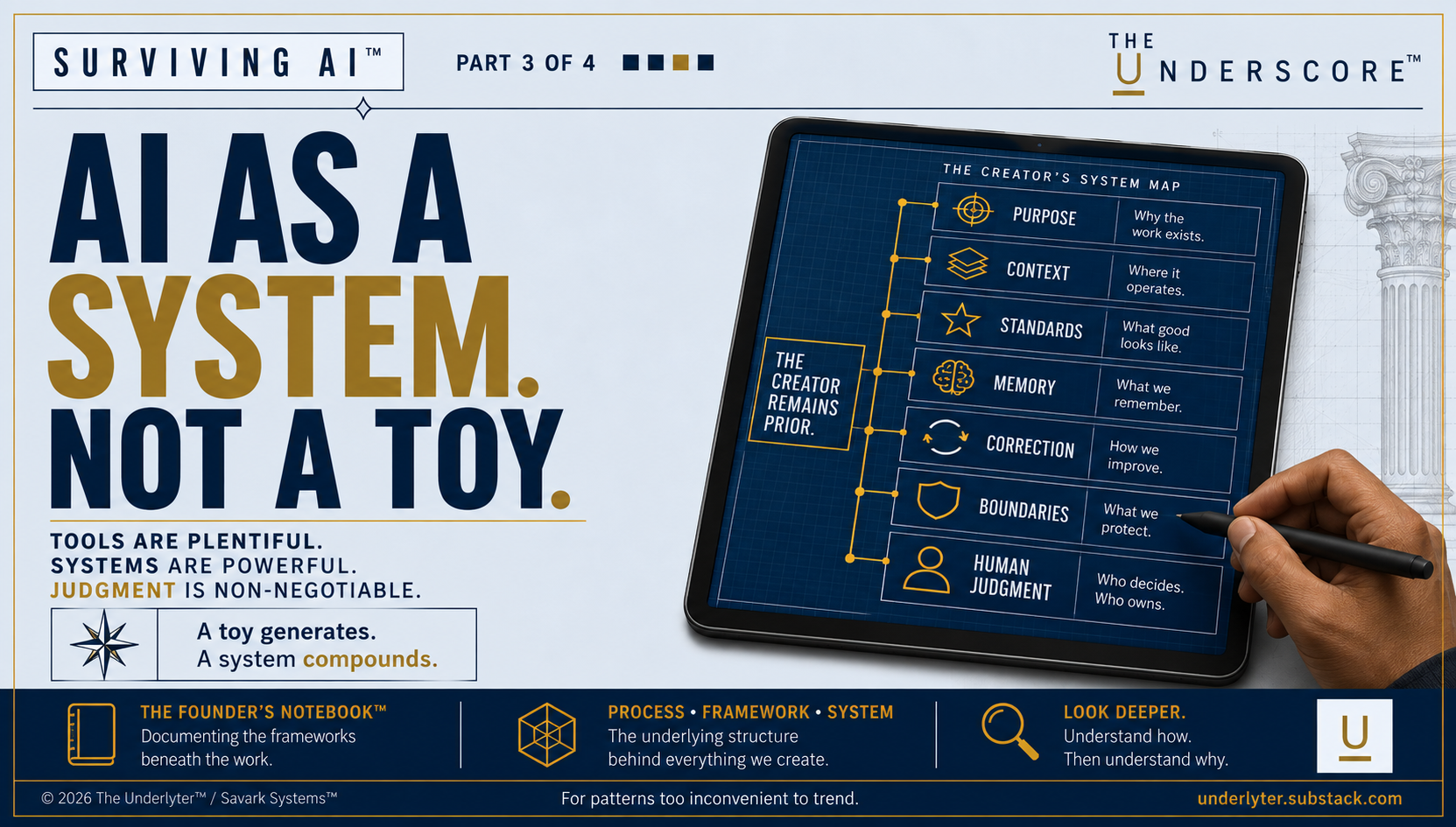
SURVIVING AI™ ― Part 3
This article did not become stronger because the AI became smarter.
It became stronger because the process became more governed.
The first draft had a thesis.
The second draft had authority.
The third draft had structure.
But it was still missing its own best evidence.
It was arguing that AI should be treated as a system instead of a toy, but the article itself had not yet become the proof of that claim.
Then I moved the piece through my writing stack.
Not a magic prompt.
Not a clever trick.
A governed system.
A living framework of prior essays, publication lanes, voice standards, memory, correction habits, diagnostic logic, and human judgment.
That system caught what the draft itself could not yet see:
The article was supposed to be the proof.
That is the point.
A less governed engine helped produce a strong draft.
A governed writing system revealed what the draft was actually about.
The system did not write the article for me.
It forced the article to become more honest.
That is what systems do.
They catch drift.
They expose missing structure.
They turn isolated output into continuity.
They make the work answer to something larger than the first thing the machine produced.
And that is why most people are not failing with AI because the tools are weak.
They are failing because they are using powerful tools without a system.
They ask one-off questions. They chase novelty. They treat the prompt box like a slot machine and then act surprised when it pays out confetti.
That is not a workflow.
That is not authorship.
That is not strategy.
That is toy behavior.
A toy surprises you.
A system compounds.
This is the third movement in my Surviving AI sequence.
The Prompt Is Not the Process argued that the prompt is only the visible trace of invisible labor: observation, research, conversation, correction, rejection, taste, memory, discipline, and judgment.
The Framework Is Mine argued that the machine did not invent the standard, the distinctions, the diagnosis, the symbolic language, or the decision tree. It responded inside a structure I built.
Now comes the practical question.
Once the process is real...
Once the framework is mine...
What turns the tool into leverage?
Not better prompting.
Not novelty.
Not magic.
System.
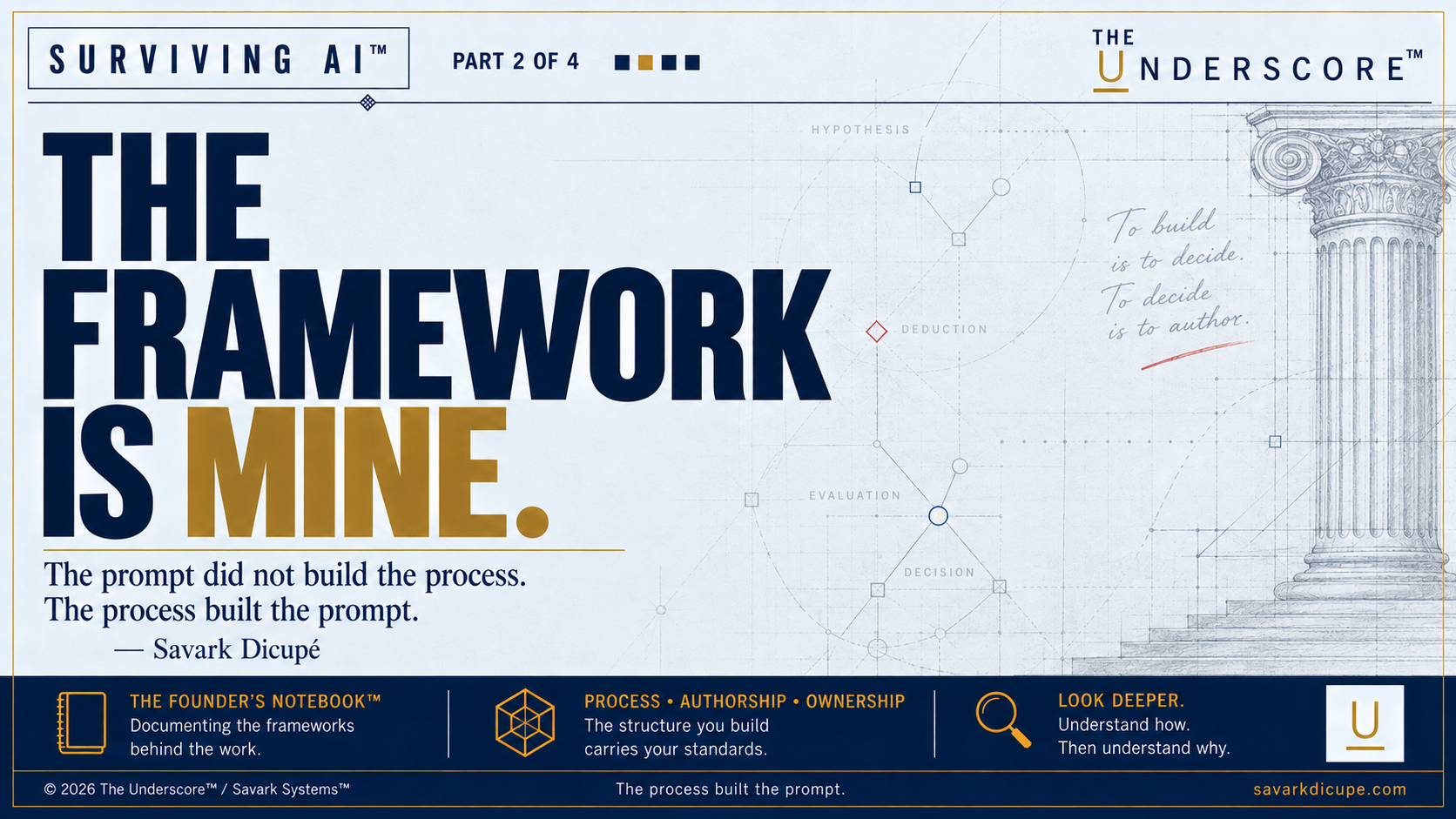
SURVIVING AI™ ー Part 2
People keep thinking they are attacking AI.
Often, they are not.
They’re reacting to the strength of the framework behind the output.
That distinction matters more than most people realize.
Because once a result unsettles them, many critics reach for the nearest available downgrade. They do not want to ask whether the pattern recognition is strong, whether the moral architecture is coherent, whether the judgment is sound, or whether the authorship is real.
They want a shortcut.
So they say: You used AI.
As if that ends the inquiry.
It doesn’t.
It only reveals how badly authorship is still misunderstood.
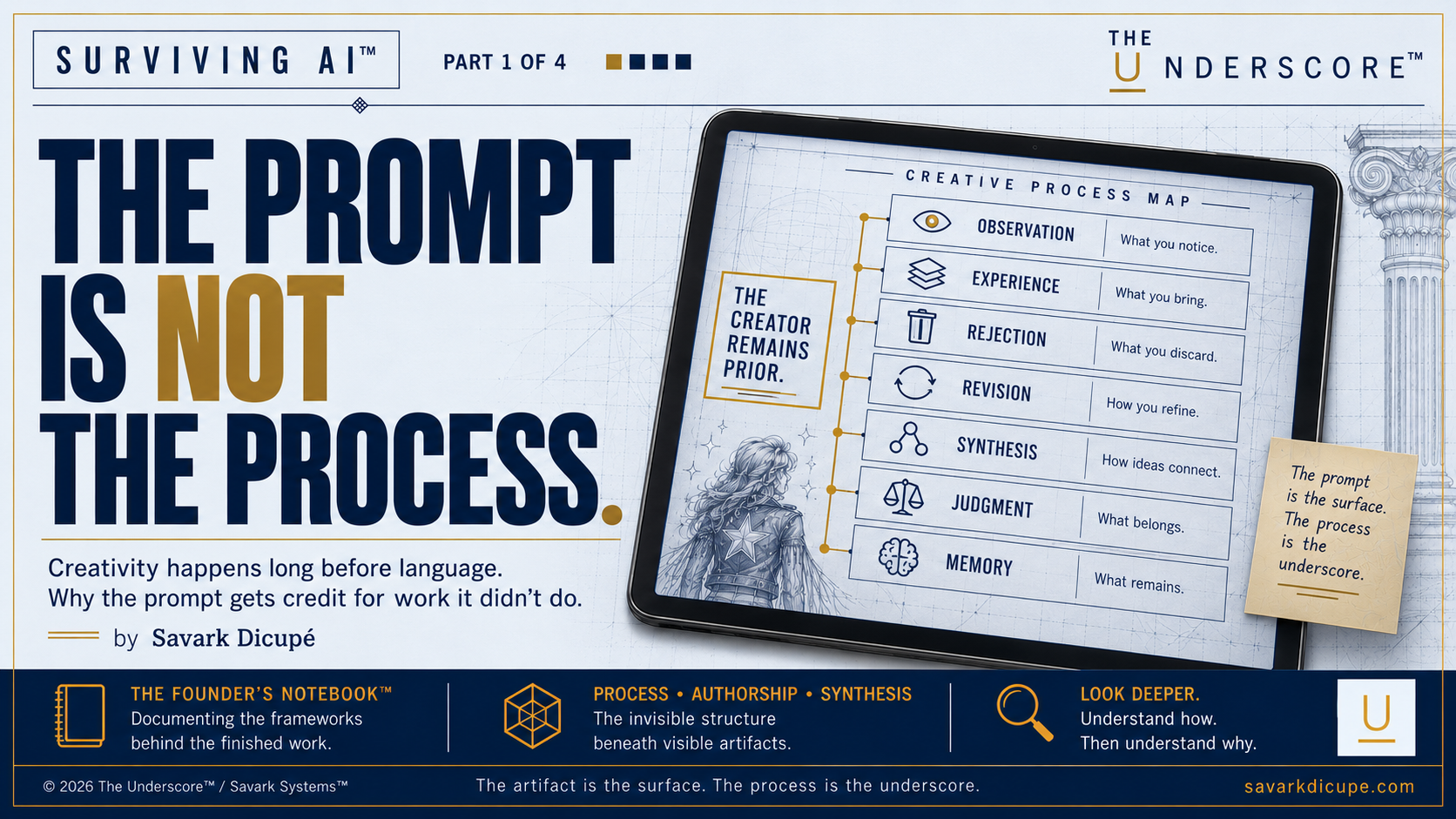
SURVIVING AI™ – Part 1
People keep asking me the same question.
"What prompt did you use?"
It's an understandable question.
It's also the wrong one.
Not because prompts don't matter.
They do.
But they're not where the creativity lives.
The prompt is simply the first thing you can see.
People mistake the first visible artifact for the first creative act.
They always have.
A novelist publishes a manuscript.
People don't see the notebooks.
A scientist publishes a paper.
People don't see the failed experiments.
An architect unveils a building.
People don't see the years spent learning proportion, structure, and materials.
An artist finishes a painting.
People ask how long it took.
The answer is almost always wrong.
Because the painting didn't take six hours.
It took twenty years.
The six hours were simply the first part the audience got to witness.
The visible artifact is rarely the beginning.
It's the moment the invisible process finally enters the room.
I believe AI has exposed that misunderstanding in a way no previous technology could.
People see a prompt.
They assume they've found the source.
They haven't.
They've found the receipt.
They've mistaken it for the meal.
---
When people ask me what prompt I used, they're asking the wrong question.
The better question is:
What invisible process made this prompt inevitable?
That answer is considerably longer.
Long before there was a prompt, there were conversations.
Conversations with Juracán GPT.
Not commands.
Conversations.
Research.
Questions.
Arguments.
Corrections.
Sketches.
Observations.
Philosophical rabbit holes.
Tiny details that seemed unrelated until suddenly they weren't.
The shape of a necklace.
The psychology of a performer.
The history of a comic-book character.
The way a pair of transparent earrings bent light on a Sunday morning news program.
The realization that they couldn't possibly be glass because they'd be too heavy.
Most people would dismiss moments like that as trivia.
I don't.
Because that's how my mind works.
I collect observations.
I test them.
I connect them.
I refine them.
Over time, those observations become standards.
Those standards become judgment.
That judgment becomes a point of view.
Only then does a prompt appear.
By the time I type one, the creative work is already well underway.
Sometimes it has been underway for years.
The prompt doesn't contain the process.
It inherits it.
That realization changed the way I think about AI.
In fact...
It changed the way I think about creativity itself.